Exploring Uncertainty [Artist Interview]
Austin Community College
October 2025
VIDEO TRANSCRIPT:
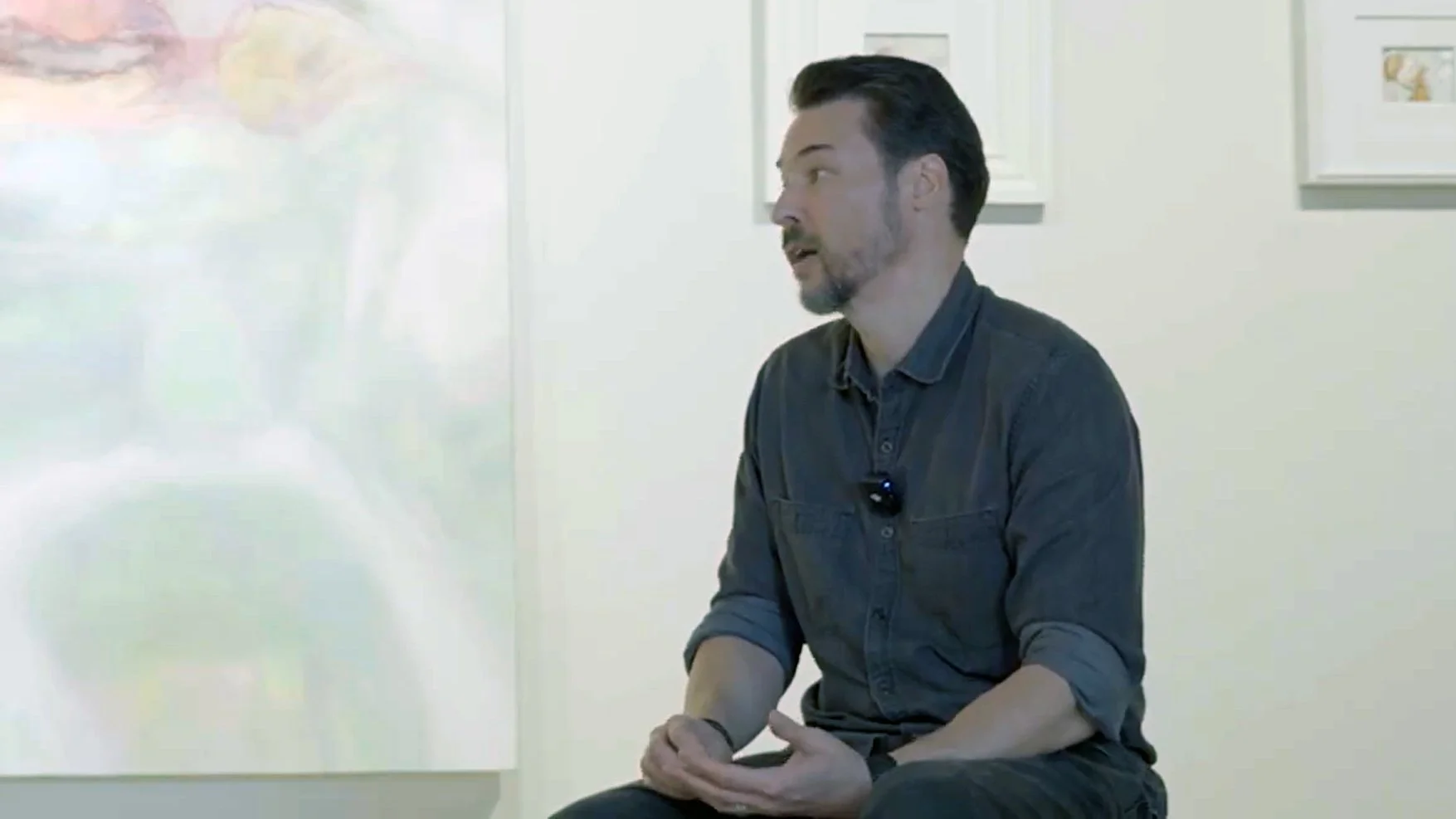
Christopher Miñán Fitzgerald discusses his Patients series with Soleil Parks, which is featured in Exploring Uncertainty: An Interactive Exhibition at Austin Community College.
Thank you for being here. So, to start out, if you could just tell us a little bit about your artistic background and yourself.
I really became an artist in many ways, I suppose, because of my kind of grappling with the coexistence of human suffering and the amount of beauty that I see in the world. And so, the making of art is a way for me to process those conflicts. I'm currently a teacher of art as well, at Concordia University, Texas.
Could you introduce the body of work that you have in the show today?
Yes. So, the paintings behind me here are representative about over a decade, I would say about 15 years of being with people that are near the end of their life or on some sort of life-support apparatus. I've lost many family members and friends over those years and that's what kind of spurred it on. So our grandfather was on oxygen up in the Midwest. We went to go visit him like in the last week of his life. We didn't know it was the last week, a few days before he passed. I decided I would just do some watercolors of him in person. It resonated with others. It resonated with me because I felt like I was providing some sense of dignity to him at the end of his life. And I just was in contact with others going through similar experiences with relatives and my own brother, my uncle and cousins, a best friend and another couple of close friends—so many people over the course of a decade. And it just kind of became what I did.
You touched on this idea of sort of giving dignity to people in this position. That's something that as we've been talking with students about these works, we've been talking a lot about how you can sort of give this very human perspective on people in this position. And I was wondering what you think about what it gives to the people that you're drawing.
There is a notion of questioning how to articulate this problem—this existence of human suffering or articulate how we feel we want to like solve it or what's the solution. I don't think it's philosophical. I don't think it's theological. I think it's primarily pastoral. And what I mean by that is it’s really about just being present with people in their grieving, in their mourning, in their uncertainty, in the situations that are tragic. So the paintings are again that invitation to be present with ourselves as a viewer and hopefully that empowers people to be more present with those around them when these kind of situations arise.
You also just mentioned uncertainty and in the Exploring Uncertainty exhibition, how in your words do you feel like your work engages with that theme?
I feel like the work confronts the amount of absolute certainty that we all sort of surround ourselves with or kind of try to feel comfortable in. And the paintings are meant to kind of dislodge that a bit because I feel certain that I'm not going to be hit by a car when I walk out of this building. Just this kind of certainty that we take for granted about things.
In regard to your larger body of work, thematically, process-wise, how do you feel like this series fits into that body of work?
Well early on, I began to make art, watercolor was my first love. I suppose it might be that way for many people. Drawing is kind of an entry into art making and so it feels like a homecoming in that sense, that I went back to watercolor because I hadn't really done watercolor since I was quite young. Striving to investigate these themes for me felt powerful from a young age being in a hospital myself. Connecting that with the way in which I made the work using the watercolor just felt right, you know. Then moving into the bigger ones with the acrylic and oil was kind of a way to bring the technical narrative you could call it, the material narrative of what I can do now as an adult artist, and kind of recalibrate how what I make connects with my initial intuition to create these watercolor portraits.
It's been really interesting speaking to all the artists now to see how their thought processes and artistic processes all actually fit well together. I'd love if you could maybe expand on how your artistic methodology sort of affects your message. What is the intention behind going so ambiguous and so loose.
If you think about the famous photograph Dorothea Lange took at the beginning of photojournalism during the Dust Bowl—not even getting the name of the peasant mother that she takes a picture of and becomes famous for…you ride the line of exploitation, I suppose, of people suffering. So making a certain kind of like documentational image that's very strict, I wouldn't say photographic because it's not the photo in and of itself that would be that, but just something that is devoid of any kind of transcendent qualities. If I just went so tight and it was exactly what I see and that's it, I don't think it would invite the kind of space for really exploring a sense of hope, a sense of beauty, a sense that there's something more here than just visually what's happening. I'm trying to make something that's epic, you know, trying to make something that's transcendent in the spirit of an older artistic style/tradition.